Wednesday, June 28, 2017

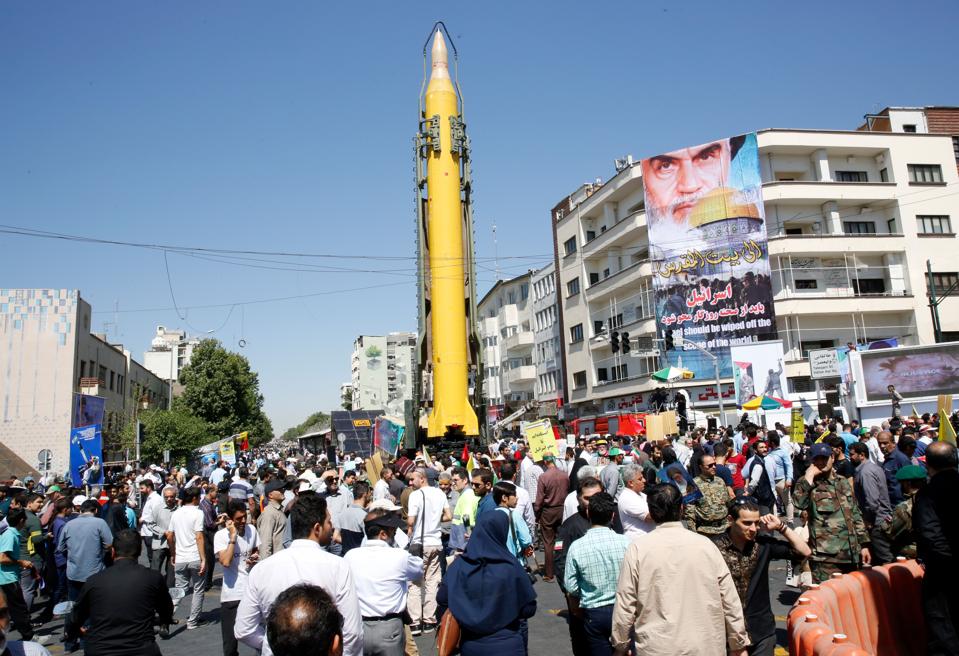
IRAN IS FLEXING ITS MUSCLES


by Dr. Majid Rafizadeh
Iran’s military adventurism and destabilizing behavior have reached an unprecedented level that could turn regional tensions into a conflagration. Tehran’s stepped-up interference in Yemen is a direct threat to the Bab Al-Mandab strait and the security of neighboring countries. US officials say Iran is now providing cruise missiles to Yemen’s Houthis.
In Iraq, Tehran is obstructing efforts by state and non-state actors to bridge Sunni-Shiite gaps. It seeks to control Iraq, and has started a widespread campaign to influence decision-making and secure a victory for Shiite groups in parliamentary elections.
“Iran has been interfering even in the decision of the Iraqi people,” said Iraqi Vice President Iyad Allawi. “We don’t want an election based on sectarianism. We want an inclusive political process... We hope that the Iraqis would choose themselves without any involvement by any foreign power.”
In other Arab nations, Iran is trying to increase its influence by inciting instability and conflict. For example, the Saudi navy recently captured a boat with three members of Iran’s Revolutionary Guard Corps (IRGC) near the Kingdom’s offshore Marjan oilfield.
“This was one of three vessels which were intercepted by Saudi forces. It was captured with the three men on board, the other two escaped,” said the Saudi Information Ministry. The captured IRGC members “are now being questioned by Saudi authorities.”
Regarding Syria, in an unprecedented move, Iran fired its first ballistic missile abroad in nearly two decades. This violates Syrian sovereignty and UN Resolution 2231, which “calls upon Iran not to undertake any activity related to ballistic missiles.” Despite Tehran violating the resolution 11 times, the UN Security Council has not punished it.
The US and the international community should hold Iranian leaders accountable. This can be accomplished by a combination of political pressure, economic sanctions and force.
Dr. Majid Rafizadeh
Iran’s missile attack on Syria is a highly significant and perilous development, as it has repeatedly boasted that its ballistic missiles can reach any country in the region. They are also capable of carrying nuclear warheads; it is believed that this is Iran’s intention.
It has been so emboldened that it is openly boasting about the ,  attack, and Iranian generals have admitted on state television that it was a warning to enemies. “The Saudis and Americans are especially receivers of this message,” said Gen. Ramazan Sharif of the IRGC.
Iran is beginning a new stage in its interventions in Arab countries via its ballistic missile capabilities. This will intensify sectarianism, radicalization and militarization of regional conflicts. If this is met with silence, Tehran will be further empowered and emboldened because it interprets silence as weakness.
The US and the international community should hold Iranian leaders accountable. This can be accomplished by a combination of political pressure, economic sanctions and force. The US should seek assistance from European allies and a united front with several Middle Eastern powers; this would be a powerful bulwark against Tehran. Sanctions from Muslim countries would be a significant blow to Tehran’s self-portrayal as a leader of the Muslim world.
• Dr. Majid Rafizadeh is a Harvard-educated, Iranian-American political scientist. He is a leading expert on Iran and US foreign policy, a businessman and president of the International American Council. He serves on the boards of the Harvard International Review, the Harvard International Relations Council and the US-Middle East Chamber for Commerce and Business. He can be reached on Twitter @Dr_Rafizadeh.
originally published in the Arabnews
source:IRAN IS FLEXING ITS MUSCLES

Tuesday, June 27, 2017

IS IRAN PLUNGING THE MIDDLE EAST INTO ANOTHER WAR?


By Heshmat Alavi,
The days of ISIS are numbered and voices are heard about the entire region being forced into a far more disastrous conflict. Various parties, mainly the US and Iran, have begun jostling, seeking to inject their influence onto what the future holds for Syria.As Iran has also wreaked havoc in Iraq and Yemen, concerns are rallying on Tehran going the distance to pull the US full-scale into the Syria inferno.
Such a mentality results from misunderstanding the nature of what is known as the Iranian regime.

Escalating tensions

After establishing a foothold in the strategic town of al-Tanf near the Iraq-Jordan-Syria border, US forces designated a buffer zone to provide protection for their own troops and resources, alongside their allies of anti-Assad opposition rebels.
1) On three different incidents Iran-backed militias have made advances into the buffer zone, only to receive warnings and eventually be attacked by US warplanes.
2) Raising the stakes, on two occasions Iran-made pro-Assad drones have been downed by US-led coalition forces.
3) And maybe the ultimate incident came when a US F/A-18 fighter jet shot down a Syrian Sukho-22 warplane after the latter dropped bombs on US-backed Kurdish forces north of Raqqa, the self-declared capital of ISIS.

Tehran’s habit

Understanding its conventional and non-conventional forces stand no match against the classical armies of the US and the unity of its Arab allies, Iran has for the past 38 years resorted to tactics of its own.
Terrorist attacks across the region through proxy groups such as the Lebanese Hezbollah have proven successful. The 1982 Beirut bombings of US and French barracks led to the American pullout of this highly fragile country. As a result, Tehran has used this method ever since to send its message. Following the wars of Afghanistan and Iraq, Iran yet again resorted to paramilitary and proxy methods to advance its interests in the region.
Seeing no strong response only emboldens Iran in its pursuit of wreaking havoc. Witnessing the disastrous and premature withdrawal of US forces from Iraq, and Obama’s refusal to live up to his own red line after Assad resorted to the extreme low of gassing his own people in 2013, Iran came to a conclusion such actions will continue unabated.

The language of force

There have been cases otherwise, however, including Operation Praying Mantis on April 18th, 1988 when the US Navy launched a campaign against Tehran’s naval fleet in retaliation for the Iranian mining of the Persian Gulf during the Iran–Iraq war and the subsequent damage to an American warship.
The attack came as a major wake-up call for Iran as the mullahs in Tehran only understand the language of force. The 59 cruise missiles the US used to target the Syrian regime airfield used to launch a chemical attack on Homs earlier this year also rose eyebrows not only in Damascus, Moscow and Tehran, but the world over.
The recent incidents in Syria are further serious signals for Iran that such belligerence no longer will go tolerated, especially considering a new US administration in Washington adopting a far different perspective and strategy than its predecessor.

Solution

What needs grave understanding is the fact that Iran is the last party that seeks a full blown war in Syria, ,  or any other region of the Middle East. The Middle East is seeking a win-win solution, enjoying an open hand in meddling across the region to such extent to prevent any major international community retaliatory action.
Has Iran been successful? To this day, mostly it has, unfortunately, thanks to the West’s highly flawed belief in adopting a policy of engagement with Iran to tame the mullahs and enjoy short-term economic gains.
The tides, however, are changing for the better. Iran’s Achilles Heel must be the main target as seen in the recent US Senate resolution imposing sanctions on the regime’s ballistic missile program, support of terrorism and human rights violations.
Tehran may kick, scream and threaten to abandon the Iran nuclear deal in retaliation. Yet rest assured the mullahs will not make such a grave mistake, triggering the automatic re-imposition of sanctions under six previous United Nations Security Council resolutions.
Iran’s Revolutionary Guards lies at the heart of the mullahs’ illicit activities both inside the country and abroad. This entity also controls around 40 percent of the country’s already fragile and highly corrupt economy.
To this end, there is no need for another war in the region. Iran knows better that such an outcome would only accelerate developments against its interests. The US and Arab world can and should lead the international community by designating the Revolutionary Guards as a foreign terrorist organization.
This will be a complementary measure to the abovementioned Senate resolution, and bring Tehran to its knees. Such an initiative will place the international community alongside the Iranian people in their struggle against the ruling mullahs’ regime.
This is especially true after US Secretary of State Rex Tillerson referred to Washington’s support for domestic forces seeking peaceful regime change in Iran.

Monday, June 26, 2017

Understanding The Threats Of Iran


By :Heshmat Alavi ,


US President Donald Trump’s visit to Saudi Arabia and the Riyadh Summit, with leaders of over 50 Muslim nations taking part, was a major turning point in the Middle East’s balance of power. This development also signaled the end of eight years of the Obama administration’s unbridled appeasement vis-à-vis Iran. And Tehran has very specifically received the message.
For the first time in many years the world is taking steps to stand on the right side of history and alongside the Iranian people in their quest to realize their rightful demands of freedom, democracy and peace in the region.
The Iranian opposition National Council of Resistance of Iran (NCRI), led by Maryam Rajavi, welcomed the results of this conference. Mohammad Mohaddessin, Chairman of the NCRI Foreign Relations Committee and author of the book “Islamic Fundamentalism: The New Global Threat,” shared his opinion and the Iranian opposition’s stance in this regard.
Mohammad Mohaddessin, Chairman of the NCRI Foreign Relations Committee
irannewsupdate.com
Mohammad Mohaddessin, Chairman of the NCRI Foreign Relations Committee
  1. At a time when ISIS in Iraq has suffered major defeats, can Iran claim to deliver a solution? Especially since the Iran-backed Hashid al-Sha’bi militias have apparently played a major role in this regard?
Let’s be clear. Hashid al-Sha’bi and Iran’s Revolutionary Guards (IRGC), as its true commander, have not played a major role in the fight against ISIS. Iran-backed forces have taken advantage of US airpower and only filled the void of ISIS on the ground after their defeats. This means a large portion of Sunni areas in Iraq is under their control. US inaction in the face of Iran in the past 16 years opened windows to most opportunities for this regime.
The most important element threatening Iraq, and especially peace and tranquility in the entire region, is the presence of IRGC and Shiite militias to replace the void of ISIS. This is a major challenge facing the US today. The war against ISIS will not render peace and security in the Middle East without the complete eviction of Iran’s IRGC and militias from Iraq and Syria.
  1. There are voices, especially in the US, heard claiming blacklisting the IRGC will do against international efforts, and especially US forces in defeating ISIS. Will designating the IRGC as a terrorist entity decrease regional crises?
First I must ask does the IRGC truly seek the complete annihilation of ISIS. This is an illusion promoted by Iran and its allies in the West to enjoy the pensions of fighting ISIS. It is true that Iran and ISIS are facing off in some areas. However, Tehran and its militias are seeking to replace the Sunni ISIS with their Shiite flag. Such a mentality and objective itself religiously and socially strengthens the very philosophy behind ISIS’ existence.
Look how it all started. The crimes committed by Syrian dictator Bashar Assad and former Iraqi prime minister Nouri al-Maliki provided the social grounds for ISIS’ birth by releasing al-Qaeda prisoners or allowing their escape. ISIS has also enjoyed IRGC logistical, substantial and arms support. Many senior ISIS members lived in Iran for years and Tehran dispatched them to Iraq and Syria with the aim of launching a sectarian war.
source:Understanding The Threats Of Iran

Sunday, June 25, 2017

U.S. Congress Sponsors Resolution Seeking Justice for MEK Members Massacred by Iran Regime in 1988


Iran Focus
London, 22 Jun - Forty-Six US Congressmen and women have sponsored a resolution which calls on the US Government and its allies across the world to publically condemn the 1988 massacre of Iranian political prisoners and calls on the UN to launch an investigation into this crime against humanity.
Unlike much in Congress nowadays, Resolution 188 (officially titled: The condemnation of the Iranian government for the massacre of political prisoners in 1988 and the invitation to call for justice for the victims) receives wide bipartisan support.
The main victims of the massacre were members of the People's Mujahedin of Iran (PMOI/MEK), an anti-fundamentalist group who espoused equal rights, a secular government and a ban on the death penalty, whom the Regime wanted to exterminate because the opposition was becoming too strong.
The resolution stipulates that those responsible for the brutal massacre of the MEK should be held to account for their roles. None of them have ever been punished for this slaughter, not even under the supposed moderate Hassan Rouhani; who interestingly cannot account for his whereabouts during the massacre.
Last year, the Iranian Resistance, which includes the MEK as its largest group, revealed the names of 59 current Regime officials who were involved in the massacre of the MEK, including “Justice” Minister Mostafa Pourmohammadi. Head of the Supreme Disciplinary Court for Judges Hossein-Ali Nayyeri, and Ebrahim Raisi, a member of the Assembly of Experts and 2017 presidential candidate.
Some of the co-sponsors include:
• Michael McCaul (Chair of the House Homeland Security Committee)
• Ed Royce (Chair of the Foreign Affairs Committee)
• Eliot Engel (ranking member of the House Foreign Affairs Committee)
• Pete Sessions (the Chair of House Rules Committee)
• Barbara Comstock
• Tom MacClintock
• Bill Keating
• Brad Sherman
• Donald Young
• Judy Chu
Back in March, six human rights organisations who consult with the UN signed a joint statement calling for justice for the MEK titled: “The 1988 massacre of political prisoners in Iran constitutes a crime against humanity”.
They recommended that the UN appoint a commission to investigate the massacre of the MEK and that the Special Rapporteur on the human rights situation in Iran, Asma Jahangir and Special Rapporteur on the promotion of truth, Pablo de Greiff, carry out an inquiry into the massacre.
Massacre of MEK

Then-Supreme Leader of Iran, Ruhollah Khomeini ordered a Fatwa to slaughter MEK members and supporters, even if they had already been sentenced to jail for their beliefs or already served their sentence in full.
The MEK supporters were put through a mock trial which lasted all of five minutes, where they were asked ‘What is your political affiliation?’ before being sentenced to death. They were then buried in secret mass graves and their families were given no information on them.
This move was criticised by then-heir to the supreme leader Hossein Ali Montazeri, who wanted the Death Commissions against executing pregnant women as it violated Shiite law and called the massacre "the greatest crime that the Islamic Republic of Iran has committed and the history will condemn us".
He was then stripped of his power and sentenced to house arrest until his death in 2009. His comments came to light last year, after his son, Ahmad, released the audio of the conversation online. Ahmad was then sentenced to 21 years in prison.
In February, a political science professor at Tehran State University, who supported President Rouhani admitted to the massacre on his website.
Sadegh Zibakalam wrote: “The Iranian regime, has killed thousands of MEK members just like killers of Imam Hossain (a 7th-century revolutionary Shiite leader who made the ultimate sacrifice for social justice in the face of corruption and tyranny). Thousands of members of the People's Mujahedeen opposition organisation (MEK) were killed without any trial and any proof of the crime on them, during the first years after the revolution.”
More about the People’s Mojahdin Organization of Iran (PMOI/ MEK)
The People’s Mojahedin Organization of Iran (Also known as MEK, or Mujahedin-e-Khalq / Mujahedeen-e-Khalq), was founded on September 6, 1965, by Mohammad Hanifnejad, Saeed Mohsen, and Ali-Asghar Badizadgan. All engineers, they had earlier been members of the Freedom Movement (also known as the Liberation Movement), created by Medhi Bazargan in May 1961.1
The MEK’s quest culminated in a true interpretation of Islam, which is inherently tolerant and democratic, and fully compatible with the values of modern-day civilization. It took six years for the MEK to formulate its view of Islam and develop a strategy to replace Iran’s dictatorial monarchy with a democratic government.
MEK’s interpretation of Islam

The theocratic mullah regime in Iran believe interpreting Islam is their exclusive domain. The MEK reject this view and the cleric’s reactionary vision of Islam. The MEK’s comprehensive interpretation of Islam proved to be more persuasive and appealing to the Iranian youth.
MEK’s founders and new members studied the various schools of thought, the Iranian history and those of other countries, enabling them to analyze other philosophies and ideologies with considerable knowledge and to present their own ideology, based on Islam, as the answer to Iran’s problems.
MEK’s leadership’s arrest during the 70s.
The Shah’s notorious secret police, SAVAK, arrested all MEK leaders and most of its member’s in1971. On May 1972, the founders of the MEK, Mohammad Hanifnejad , Saeed Mohsen and Ali Asghar Badizadegan, along with two members of the MEK leadership, Mahmoud Askarizadeh and Rasoul Meshkinfam, were put before death squads and were executed after long months of imprisonment and torture.
They were the true vanguards, who stood against the dictatorial regime of Shah. However, they are also recognized for their opposition to what is today known as Islamic fundamentalism.
The death sentence of Massoud Rajavi, a member of MEK’s central committee, was commuted to life imprisonment as a result of an international campaign by his Geneva based brother, Dr. Kazem Rajavi (assassinated in April 1990 in Geneva by mullahs’ agents) and the personal intervention of the French President Georges Pompidou and Francois Mitterrand. He was the only survivor of the MEK original leadership.
Massoud Rajavi’s critical role in characterizing religious extremism
From 1975 to 1979, while incarcerated in different prisons, Massoud Rajavi led the MEK’s struggle while constantly under torture for his leading position.
Massoud Rajavi stressed the need to continue the struggle against the shah’s dictatorship. At the same time, he characterized religious fanaticism as the primary internal threat to the popular opposition, and warned against the emergence and growth of religious fanaticism and autocracy. He also played a crucial role when some splinter used the vacuum in the MEK leadership who were all executed or imprisoned at the time, to claim a change of ideology and policy. Massoud Rajavi as the MEK leader condemn these individual’s misuse of MEK’s name while continuing to stress the struggle against dictatorship. His efforts while still in prison forced these individuals to no longer operating under the name of MEK and adopting a different name for their group. These positions remained the MEK’s manifesto until the overthrow of the shah’s regime.
Release of Political Prisoners on the last days of the Shah
A month before the 1979 revolution in Iran, the Shah was forced to flee Iran, never to return. All democratic opposition leaders had by then either been executed by the Shah’s SAVAK or imprisoned, and could exert little influence on the trend of events. Khomeini and his network of mullahs across the country, who had by and large been spared the wrath of SAVAK, were the only force that remained unharmed and could take advantage of the political vacuum. In France, Khomeini received maximum exposure to the world media. With the aid of his clerical followers, he hijacked a revolution that began with calls for democracy and freedom and diverted it towards his fundamentalist goals. Through an exceptional combination of historical events, Shiite clerics assumed power in Iran.
Khomeini’s gradual crackdown on MEK in fear of their popular support
In internal discourses, Rajavi the remaining leader of the MEK, argued that Khomeini represented the reactionary sector of society and preached religious fascism. Later, in the early days after the 1979 revolution, the mullahs, specifically Rafsanjani, pointed to these statements in inciting the hezbollahi club-wielders to attack the MEK.
Following the revolution, the MEK became Iran’s largest organized political party. It had hundreds of thousands of members who operated from MEK offices all over the country. MEK publication, ‘Mojahed’ was circulated in 500,000 copies.
Khomeini set up an Assembly of Experts comprised of sixty of his closest mullahs and loyalists to ratify the principle of velayat-e faqih (absolute supremacy of clerical rule) as a pillar of the Constitution. The MEK launched a nationwide campaign in opposition to this move, which enjoyed enormous popular support. Subsequently, the MEK refused to approve the new constitution based on the concept of velayat-e faqih, while stressing its observance of the law of the country to deny the mullahs any excuse for further suppression of MEK supporters who were regularly targeted by the regime’s official and unofficial thugs.
Khomeini sanctioned the occupation of the United States embassy in 1979 in order to create an anti-American frenzy, which facilitated the holding of a referendum to approve his Constitution, which the MEK rejected.
MEK’s endeavors to participate in the political process avoiding an unwanted conflict with government repressive forces
The MEK actively participated in the political process, fielding candidates for the parliamentary and presidential elections. The MEK also entered avidly into the national debate on the structure of the new Islamic regime, though was unsuccessful in seeking an elected constituent assembly to draft a constitution.
The MEK similarly made an attempt at political participation when [then] Massoud Rajavi ran for the presidency in January 1980. MEK’s leader was forced to withdraw when Khomeini ruled that only candidates who had supported the constitution in the December referendum – which the MEK had boycotted- were eligible. Rajavi’s withdrawal statement emphasized the MEK’s efforts to conform to election regulations and reiterated the MEK’s intention to advance its political aims within the new legal system”. (Unclassified report on the People’s Mojahedin Organization of Iran(PMOI/ MEK) by the Department of State to the United States House of Representatives, December 1984.)
However, the MEK soon found itself in a direct struggle against the forces of the regime’s Supreme leader. The MEK’s differences with Khomeini dated back to the 1970s, and stem from its opposition to what is known today as Islamic extremism. Angry at the position taken by the MEK against his regime and worried about the MEK’s growing popularity, Khomeini ordered a brutal crackdown against the MEK and its supporters. Between 1979 and 1981, some 70 MEK members and sympathizers were killed and several thousand more were imprisoned by the Iranian regime.
June 20, 1981- Khomeini’s order to open fire on peaceful demonstration of half-a-million supporters of MEK
The turning point came on 20th June 1981, when the MEK called a demonstration to protest at the regime’s crackdown, and to call for political freedom which half-a-million supporters participated at. Khomeini ordered the Revolutionary Guards to open fire on the swelling crowd, fearing that without absolute repression the democratic opposition (MEK) would force him to engage in serious reforms – an anathema as far as he was concerned; he ordered the mass and summary executions of those arrested.
Since then, MEK activists have been the prime victims of human rights violations in Iran. Over 120,000 of its members and supporters have been executed by the Iranian regime, 30,000 of which, were executed in a few months in the summer of 1988, on a direct fatwa by Khomeini, which stated any prisoners who remain loyal to the MEK must be executed.
Having been denied its fundamental rights and having come under extensive attack at the time that millions of its members, supporters and sympathizers had no protection against the brutal onslaught of the Iranian regime, the MEK had no choice but to resist against the mullahs’ reign of terror.
“Towards the end of 1981, many of the members of the MEK and supporters went into exile. Their principal refuge was in France. But in 1986, after negotiations between the French and the Iranian authorities, the French government effectively treated them as undesirable aliens, and the leadership of the MEK with several thousand followers relocated to Iraq.” (Judgment of the Proscribed Organizations Appeal Commission, November 30, 2007.)
MEK Today
The MEK today is the oldest and largest anti-fundamentalist Muslim group in the Middle East. It has been active for more than a half century, battling two dictatorships and a wide range of issues. The MEK supports:
• Universal suffrage as the sole criterion for legitimacy
• Pluralistic system of governance
• Respect for individual freedoms
• Ban on the death penalty
• Separation of religion and state
• Full gender equality
• Equal participation of women in political leadership. MEK is actually led by its central committee consist of 1000 women.
• Modern judicial system that emphasizes the principle of innocence, a right to a defense, and due process
• Free markets
• Relations with all countries in the world
• Commitment to a non-nuclear Iran
The MEK remains a strong and cohesive organization, with a broad reach both worldwide and deep within Iran. MEK is the leading voice for democracy in Iran, supported by its interpretation of Islam that discredits the fundamentalist mullahs’ regime.
source:U.S. Congress Sponsors Resolution Seeking Justice for MEK Members Massacred by Iran Regime in 1988

Saturday, June 24, 2017

IRAN: New Admissions Regarding 1,000 Missiles Fired at MEK Hheadquarters


Iran Focus
London, 23 Jun - That 1,000 missiles were launched to target the opposition People's Mojahedin Organization of Iran (PMOI/MEK) bases in Iraq back in 2001 has been acknowledged by Iran’s Revolutionary Guards (IRGC).
The IRGC also admitted that due to specific reservations this measure was not acknowledged publicly for many years.
According to a June 19th report by Fars news agency, “Eighteen years ago the IRGC launched a retaliatory attack and fired 1,000 missiles and long range artillery targeting PMOI/MEK bases deep inside Iraq. This included Camp Ashraf and a base in the city of al-Emara. However, this was a strategic act and sent a message.”
This was possibly based on the statement by a regime intelligence agent, Saeed Rabiee, made in a televised interview on June 19, 2017, where he said, "Eighteen years ago, after the Mojahedin-e Khalq (MEK) action to eliminate Lt. Ali Sayyad Shirazi, IRGC took a retaliatory action, firing one thousand missiles and long range artillery targeted the MEK headquarters deep into Iraqi soil, from the Ashraf’s garrison to Al-Amara.”
Also significant is a similar acknowledgement made on April 9th, 2010, by former IRGC chief Rahim Safavi. “The IRGC executed an operational plan from 4 to 8 am targeting all PMOI/MEK bases, from Camp Ashraf to a base in the city of al-Emara, by launching 1,000 missiles and long range artillery, destroying all bases and inflicted heavy casualties to them,” he said.
Chief of plainclothes agents, and a member of the faction loyal to Iranian Supreme Leader Ali Khamenei, Hassan Abbasi, also made reference to the attack. He said, “… the IRGC missile system staged an attack on Camp Ashraf, raining rockets on this base. We delivered a severe blow to the PMOI/MEK.”
Camp Ashraf was located in Iraq's Diyala province. It was similar to a small city, in that it had basic infrastructure. It was the headquarters of the exiled People's Mujahedin of Iran (PMOI/MEK). The population was approximately 3,400 in 2012 but nearly all resident were subsequently located to Camp Liberty near Baghdad International Airport. Recently, all residents were again relocated, this time to countries in Europe.
Camp Ashraf (aka US Forward Operating Base Grizzly) was situated 27.6 km northeast of the Iraqi town of Khalis, about 80 kilometers west of the Iran border and 40 kilometers north of Baghdad. On January 1, 2009, the US Government formally transferred control over to the Iraqi government.
More about the People’s Mojahdin Organization of Iran (PMOI/ MEK)
The People’s Mojahedin Organization of Iran (Also known as MEK, or Mujahedin-e-Khalq / Mujahedeen-e-Khalq), was founded on September 6, 1965, by Mohammad Hanifnejad, Saeed Mohsen, and Ali-Asghar Badizadgan. All engineers, they had earlier been members of the Freedom Movement (also known as the Liberation Movement), created by Medhi Bazargan in May 1961.1
The MEK’s quest culminated in a true interpretation of Islam, which is inherently tolerant and democratic, and fully compatible with the values of modern-day civilization. It took six years for the MEK to formulate its view of Islam and develop a strategy to replace Iran’s dictatorial monarchy with a democratic government.
MEK’s interpretation of Islam
The theocratic mullah regime in Iran believe interpreting Islam is their exclusive domain. The MEK reject this view and the cleric’s reactionary vision of Islam. The MEK’s comprehensive interpretation of Islam proved to be more persuasive and appealing to the Iranian youth.
MEK’s founders and new members studied the various schools of thought, the Iranian history and those of other countries, enabling them to analyze other philosophies and ideologies with considerable knowledge and to present their own ideology, based on Islam, as the answer to Iran’s problems.
MEK’s leadership’s arrest during the 70s.
The Shah’s notorious secret police, SAVAK, arrested all MEK leaders and most of its member’s in1971. On May 1972, the founders of the MEK, Mohammad Hanifnejad , Saeed Mohsen and Ali Asghar Badizadegan, along with two members of the MEK leadership, Mahmoud Askarizadeh and Rasoul Meshkinfam, were put before death squads and were executed after long months of imprisonment and torture. They were the true vanguards, who stood against the dictatorial regime of Shah.
However, they are also recognized for their opposition to what is today known as Islamic fundamentalism.
The death sentence of Massoud Rajavi, a member of MEK’s central committee, was commuted to life imprisonment as a result of an international campaign by his Geneva based brother, Dr. Kazem Rajavi (assassinated in April 1990 in Geneva by mullahs’ agents) and the personal intervention of the French President Georges Pompidou and Francois Mitterrand. He was the only survivor of the MEK original leadership.
Massoud Rajavi’s critical role in characterizing religious extremism

From 1975 to 1979, while incarcerated in different prisons, Massoud Rajavi led the MEK’s struggle while constantly under torture for his leading position.
Massoud Rajavi stressed the need to continue the struggle against the shah’s dictatorship. At the same time, he characterized religious fanaticism as the primary internal threat to the popular opposition, and warned against the emergence and growth of religious fanaticism and autocracy. He also played a crucial role when some splinter used the vacuum in the MEK leadership who were all executed or imprisoned at the time, to claim a change of ideology and policy. Massoud Rajavi as the MEK leader condemn these individual’s misuse of MEK’s name while continuing to stress the struggle against dictatorship. His efforts while still in prison forced these individuals to no longer operating under the name of MEK and adopting a different name for their group. These positions remained the MEK’s manifesto until the overthrow of the shah’s regime.
Release of Political Prisoners on the last days of the Shah
A month before the 1979 revolution in Iran, the Shah was forced to flee Iran, never to return. All democratic opposition leaders had by then either been executed by the Shah’s SAVAK or imprisoned, and could exert little influence on the trend of events. Khomeini and his network of mullahs across the country, who had by and large been spared the wrath of SAVAK, were the only force that remained unharmed and could take advantage of the political vacuum. In France, Khomeini received maximum exposure to the world media. With the aid of his clerical followers, he hijacked a revolution that began with calls for democracy and freedom and diverted it towards his fundamentalist goals. Through an exceptional combination of historical events, Shiite clerics assumed power in Iran.
Khomeini’s gradual crackdown on MEK in fear of their popular support
In internal discourses, Rajavi the remaining leader of the MEK, argued that Khomeini represented the reactionary sector of society and preached religious fascism. Later, in the early days after the 1979 revolution, the mullahs, specifically Rafsanjani, pointed to these statements in inciting the hezbollahi club-wielders to attack the MEK.
Following the revolution, the MEK became Iran’s largest organized political party. It had hundreds of thousands of members who operated from MEK offices all over the country. MEK publication, ‘Mojahed’ was circulated in 500,000 copies.
Khomeini set up an Assembly of Experts comprised of sixty of his closest mullahs and loyalists to ratify the principle of velayat-e faqih (absolute supremacy of clerical rule) as a pillar of the Constitution. The MEK launched a nationwide campaign in opposition to this move, which enjoyed enormous popular support. Subsequently, the MEK refused to approve the new constitution based on the concept of velayat-e faqih, while stressing its observance of the law of the country to deny the mullahs any excuse for further suppression of MEK supporters who were regularly targeted by the regime’s official and unofficial thugs.
Khomeini sanctioned the occupation of the United States embassy in 1979 in order to create an anti-American frenzy, which facilitated the holding of a referendum to approve his Constitution, which the MEK rejected.
MEK’s endeavors to participate in the political process avoiding an unwanted conflict with government repressive forces
The MEK actively participated in the political process, fielding candidates for the parliamentary and presidential elections. The MEK also entered avidly into the national debate on the structure of the new Islamic regime, though was unsuccessful in seeking an elected constituent assembly to draft a constitution.
The MEK similarly made an attempt at political participation when [then] Massoud Rajavi ran for the presidency in January 1980. MEK’s leader was forced to withdraw when Khomeini ruled that only candidates who had supported the constitution in the December referendum – which the MEK had boycotted- were eligible. Rajavi’s withdrawal statement emphasized the MEK’s efforts to conform to election regulations and reiterated the MEK’s intention to advance its political aims within the new legal system”. (Unclassified report on the People’s Mojahedin Organization of Iran(PMOI/ MEK) by the Department of State to the United States House of Representatives, December 1984.)
However, the MEK soon found itself in a direct struggle against the forces of the regime’s Supreme leader. The MEK’s differences with Khomeini dated back to the 1970s, and stem from its opposition to what is known today as Islamic extremism. Angry at the position taken by the MEK against his regime and worried about the MEK’s growing popularity, Khomeini ordered a brutal crackdown against the MEK and its supporters. Between 1979 and 1981, some 70 MEK members and sympathizers were killed and several thousand more were imprisoned by the Iranian regime.
June 20, 1981- Khomeini’s order to open fire on peaceful demonstration of half-a-million supporters of MEK
The turning point came on 20th June 1981, when the MEK called a demonstration to protest at the regime’s crackdown, and to call for political freedom which half-a-million supporters participated at. Khomeini ordered the Revolutionary Guards to open fire on the swelling crowd, fearing that without absolute repression the democratic opposition (MEK) would force him to engage in serious reforms – an anathema as far as he was concerned; he ordered the mass and summary executions of those arrested.
Since then, MEK activists have been the prime victims of human rights violations in Iran. Over 120,000 of its members and supporters have been executed by the Iranian regime, 30,000 of which, were executed in a few months in the summer of 1988, on a direct fatwa by Khomeini, which stated any prisoners who remain loyal to the MEK must be executed.
Having been denied its fundamental rights and having come under extensive attack at the time that millions of its members, supporters and sympathizers had no protection against the brutal onslaught of the Iranian regime, the MEK had no choice but to resist against the mullahs’ reign of terror.
“Towards the end of 1981, many of the members of the MEK and supporters went into exile. Their principal refuge was in France. But in 1986, after negotiations between the French and the Iranian authorities, the French government effectively treated them as undesirable aliens, and the leadership of the MEK with several thousand followers relocated to Iraq.” (Judgment of the Proscribed Organizations Appeal Commission, November 30, 2007.)
MEK Today
The MEK today is the oldest and largest anti-fundamentalist Muslim group in the Middle East. It has been active for more than a half century, battling two dictatorships and a wide range of issues. The MEK supports:
• Universal suffrage as the sole criterion for legitimacy
• Pluralistic system of governance
• Respect for individual freedoms
• Ban on the death penalty
• Separation of religion and state
• Full gender equality
• Equal participation of women in political leadership. MEK is actually led by its central committee consist of 1000 women.
• Modern judicial system that emphasizes the principle of innocence, a right to a defense, and due process
• Free markets
• Relations with all countries in the world
• Commitment to a non-nuclear Iran
The MEK remains a strong and cohesive organization, with a broad reach both worldwide and deep within Iran. MEK is the leading voice for democracy in Iran, supported by its interpretation of Islam that discredits the fundamentalist mullahs’ regime.

Friday, June 23, 2017

Widening Rifts in Iran Regime


Iran Focus
London, 22 Jun - There are further reports of a widening rift between the opposing factions in the Iranian Regime, which could spell the mullahs’ downfall.
The Guardian reports that Supreme Leader Alii Khamenei has become increasingly critical of President Hassan Rouhani, probably in response to Rouhani’s criticism of him on the campaign trail, with Khamenei even going so far as to humiliate him during a meeting of top officials.
However, just to be clear, the two men and their respective factions are not separated by policy or ideals as most political opponents are. They are merely trying to retain and increase their grasp on power.
The real divide
There is no moderate V hardliners fight in the Regime; Rouhani despite his façade of rebellion must ultimately bow to the wishes of Khamenei if he wants to remain in power. While this may seem like Rouhani is being restrained, he most definitely does not want to erode the powers of the Supreme Leader, a position he soon hopes to fill.
Rouhani knows that the most powerful man in the country is the Supreme Leader but Khamenei has been diagnosed with terminal cancer, which means that the Regime will soon need a new Supreme Leader. The best way for him to ensure a position as Supreme Leader is to hold the second most powerful position in the country, when the current Supreme Leader dies, which is the only reason that he fought so hard to be President.
Khamenei does not want Rouhani to follow him as Supreme Leader. He wanted to fix the elections in favour of Ebrahim Raisi, a member of the Death Commission that sent 30,000 members of the People’s Mojahedin Organization of Iran (PMOI/MEK) to their death in 1988, but was too scared of mass protests by the people of Iran.
Ali Ansari, director of the Institute for Iranian Studies at St Andrews University, said: “After the elections Khamenei was unhappy with the results and they’re trying to contain it.”
Khamenei even warned Rouhani against dividing the country, as happened in 1980-81, because the president who engineered that, Abolhassan Banisadr, was impeached and exiled.
The good news
Thankfully, as the Iranian Regime exposes itself as a bunch of power-hunger men, squabbling over the tiniest little thing, the Iranian Resistance is more than prepared to take over as the legitimate government.
The National Council of Resistance of Iran currently serves as a government in exile and enjoys support from around the globe. There is no more obvious show of this, than the Free Iran Rally on July 1, in Paris, where 100,000 politicians, activists, and dissidents will gather to champion president-elect Maryam Rajavi as the true leader of Iran.

Thursday, June 22, 2017

Despite nuclear deal, Iran's ballistic missile program continues unabated


by Amir Basiri

Washington Examiner Jun 21, 2017 - Iran's missile program has accelerated since the signing of the nuclear agreement between Tehran and world powers in 2015, a new report by the National Council of Resistance of Iran revealed.
According to NCRI 's findings, which were made public at a press conference held at the council's Washington office on Tuesday, the scope of Iran's missile program is much more extensive than was previously thought.The report indicates that the Revolutionary Guards, which is in charge of Iran's ballistic missile program, has been carrying out operations at 42 locations, 12 of which were previously unknown. One of the reported missile complexes is tied to SPND, the organization in charge of pursuing the building of nuclear bombs.The information disclosed by the NCRI were obtained by the People's Mojahedin of Iran (PMOI/MEK), the group that first revealed Iran's illicit nuclear program.
In an interview with Fox News, Alireza Jafarzadeh, deputy director of the NCRI's U.S. office, said, 'The findings show the first full picture of the missile program of the Iranian regime, which is very extensive and costly. It also shows a close tie between the nuclear weapons program and the missile program.'
This latest report comes against the backdrop of the Iranian regime facing setbacks at home, in the region and across the world.
'Tehran has accelerated its missile program to make up for its domestic impotence and increasing regional isolation,' Jafarzadeh said. 'The missile program of the regime is essential for its survival. Unfortunately the missile program of the Iranian regime has remained primarily unchecked.'
The nuclear accord, also known as the JCPOA, failed to address a range of threats posed by the Iranian regime, including its terrorist meddling in countries of the region, its ballistic missile program and its abysmal human rights record.
The Obama administration, which spearheaded the negotiations that led to the hammering of the deal, believed the incentives provided by the JCPOA would dampen Iran's evil ambitions. Tuesday's revelations proved once again how wrong-placed those hopes were.
Iran has largely taken advantage of the appeasement policy and hands-off approachadopted by the previous administration to pursue its illicit agendas, marked by several ballistic missile tests and launches since signing the JCPOA.
Recent developments, however, show that the tide is shifting against the Iranian regime.
Last week, the U.S. Senate passed a bill that, if approved by the House and signed by President Trump, will slap new sanctions against the Iranian regime for its ballistic missile development, arms transfers, support for terrorism, and human rights violations.
Also, at a recent summit in Riyadh, leaders of major Arab nations underlined the dangerous nature of Iran's ballistic missile program and expressed their commitment to confront Tehran's subversive and destructive activities inside their countries.
The NCRI representatives reiterated that the Iranian people deeply oppose the regime's nuclear and missile program and its interference in the region, and called for the enactment of further sanctions against the Iranian regime's missile program and all entities that are affiliated to it. They also called for the expulsion of Iran's forces and proxies from Syria and Iraq, and the terrorist designation of the Revolutionary Guards, a measure that will be crucial to curbing Iran's nefarious deeds in the region.


Amir Basiri (@amir_bas) is a contributor to the Washington Examiner's Beltway Confidential blog. He is an Iranian human rights activist.