Tuesday, September 12, 2017

Sixteen Years After 9/11, Iran Remains A Threat To America


by David Ibsen

Inside Secoutces, September 10, 2017 - After the tragic events of September 11, 2001, Americans collectively searched for answers about who was behind the terror attack and why it occurred.  While Osama bin Laden will forever be known as the mastermind of the tragedy, Iran’s role in the devastating attacks, and its collusion with al-Qaida and other terrorist organizations more generally, must not be overlooked.
An early 1990s meeting in Sudan between an emissary of Iran and al-Qaida leader Osama bin Laden, culminated in a decision to put aside Sunni-Shiadivisions in favor of an Iran-al-Qaeda pact to conspire against the U.S. As a report by the 9/11 Commission would state, “discussions in Sudan between al-Qaida and Iranian operatives led to an informal agreement to cooperate in … actions carried out primarily against Israel and the United States.”
With the help of Iran, al-Qaida developed a working relationship with Hezbollah, an Iranian terror proxy, supported both monetarily and operationally by Iran’s Islamic Revolutionary Guard Corps (IRGC). In dealings facilitated by Iran, al-Qaida sent a cohort to Hezbollah’s base in Lebanon, where their operatives received training and propaganda instruction. It was even Hezbollah’s Imad Mughniyeh who inspired bin Laden’s signature calling card – coordinated, simultaneous attacks like those seen on September 11.
Iran’s influence on al-Qaeda was confirmed years after the attack. In 2011, Judge George Daniels, presiding over the case where the family members of 9/11 victims sued al-Qaida, the Taliban, and Iran over the 2001 attacks, found that Iran was liable for its involvement.
source:Sixteen Years After 9/11, Iran Remains A Threat To America

Monday, September 11, 2017

Iranian Resistance: PMOI/MEK Elects New Secretary General


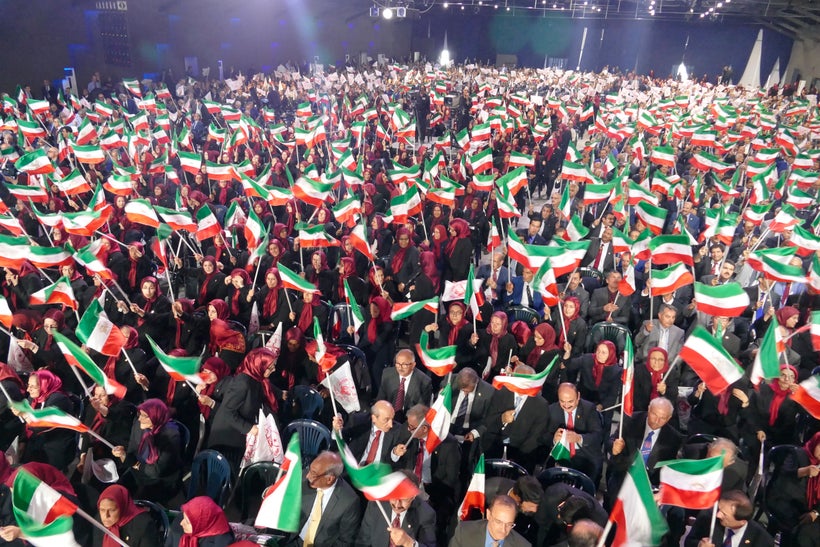
On Wednesday, September 6, 2017-- In a congress chaired by Ms. Zohreh Akhyani, the Secretary General since 2011.The People’s Mojahedin Organization of Iran, PMOI/MEK, (the Mujahedin-e Khalq, MEK) held its annual Congress simultaneously in Tirana and five other countries. On the PMOI/MEK’s 52nd anniversary, the Congress elected Ms. Zahra Merrikhi as its new Secretary General.

Election process in PMOI/MEK

According to the PMOI/MEK’s regulations, the Secretary General is elected to a renewable term of two years. The election is held in three stages. In the first stage, members of the PMOI/MEK Central Council, and in the second the organization’s officials and cadres in different departments, cast their votes in secret ballots. In the third stage, at the PMOI/MEK Congress, all members vote by raising their hands.

In the first stage, on August 20, 2017, Ms. Merrikhi was elected from among 12 candidates by a majority of the Central Council members. The four leading candidates were put on the ballot for the second phase, which was held on September 3, 2017. Ms. Merrikhi received a majority of the votes cast in ten different PMOI/MEK centers. In the final stage, during the PMOI/MEK Congress, Ms. Merrikhi was unanimously elected Secretary General.
Previously, Ms. Merrikhi was coordinator for the offices of Ms. Maryam Rajavi, the President-elect of the National Council of Resistance of Iran ( NCRI ), and Vice-President of the PMOI/MEK’s Central Council.

source:Iranian Resistance: PMOI/MEK Elects New Secretary General

Sunday, September 10, 2017

MUQTADA AL-SADR REFUSED TO MEET IRAN REGIME LEADER'S ENVOY TO IRAQ


By IF Staff
NCRI - On Tuesday, September 5, 2017. Muqtada Sadr, leader of Sadri current in Iraq, refused to meet with Hashemi Shahroudi, the envoy of Ali Khamenei, Supreme Leader of the Iranian regime.“The envoy of Khamenei carries a sectarian project that would cause loss and damage to Iraq,” Baghdad Press reported quoting Amir al-Kanani, a leader of the Sadr's current, in an explanation of the rejection to meet with envoy of Ali Khamenei to Iraq. "
Amir al-Kanani, a member of the Al-Ahrar faction, affiliated with Sadr's current in the parliament of Iraq, said in an interview: “Iran's interference in Iraqi political affairs is detrimental to Iraq’s national interests, and therefore Muqtada al-Sadr refused to accept Khamenei's emissary.”
He accused the Iranian regime of trying to foment internal conflicts and direct political currents to sectarian barricades and said: “Shahroudi's visit to Iraq is nothing but a supplementary project for a sectarian plan that Iran has provided six months ago. Iran proposed a “Shia House Unity” six months ago. Khamenei's emissary has not brought anything new to the Iraqi people.”
Al-Kanani stated: “Iran has no projects in favor of Iraq. The Iranian regime is seeking to create sectarian barracks in Iraq, based on a Shia sectarian bastion against which the bastions of Kurdish and Sunni ethnicity are formed. The Iraqis are fed up with the phases of sectarian projects and the losses they have inflicted, and they are not prepared to accept a new project in this regard.”
“Iran's interference is not in the interest of the Iraqi people who have decided to get rid of sectarian boundaries,” said Sadri's current member. “The Iraqi parliamentary election is an internal affair of the Iraqi people and has nothing to do with Iran.”
“If Iran is honest, it will propose plans for economic development and investment and the fight against terrorists in Iraq, not the sectarian project. So, it is unlikely that Muqtada Sadr will change his mind and accept Shahroudi,” he added.
Before Muqtada al-Sadr, Ayatollah Sistani also refused to meet Ayatollah Shahroudi, the emissary of Khamenei.
Iraqi news agencies, including “Al-Ghad Press”, quoting informed sources, reported that Sistani opposed the meeting with Mahmoud Hashemi Shahroudi, head of the Iran regime’s Expediency Council, who is currently in Iraq.
The sources added: “Shahroudi called for a visit with Sistani during his trip to Najaf, but Sistani opposed and rejected this request.”
Shahroudi is said to have traveled to Iraq sent by Khamenei to unite the Iraqi Shiite political currents that secure the interests of the Iranian regime.
source:MUQTADA AL-SADR REFUSED TO MEET IRAN REGIME LEADER'S ENVOY TO IRAQ

IRAN IS SENDING A DANGEROUS MESSAGE TO THE WORLD


BY  Dr. Majid Rafizadeh 
Iran has shifted policy from covertly advancing its military programs to publicly announcing progress on that front. This week, Iran’s state-owned newspapers praised its “remarkable” military advancements. Keyhan’s front page boasted about the country’s unveiling of an unmanned aerial vehicle (UAV) base, saying it is a warning to “enemies.”Quoting air defense chief Farzad Esmaili, Press TV reported that “Iran’s UAV
program has expanded in recent years with more than a dozen models,” with “functions ranging from surveillance to intelligence gathering, carrying bombs and Kamikaze operations.”
Tehran also unveiled a new surface-to-air missile, Talash-3, and two radar systems. This despite UN Security Council resolution 2231, which endorsed the nuclear deal, calling on Iran not to “undertake any activity related to ballistic missiles designed to be capable of delivering nuclear weapons, including launches using such ballistic missile technology.”
Tehran is sending a message that if any Western nation, regional power or non-state actor stands in the way of its revolutionary principles and foreign policy objectives, there will be serious military repercussions.
This is not the language of diplomacy and dialogue that the government claims to champion. It is the language of hard power, which Tehran is familiar with and heavily relies on. This language leads to further regional destabilization, insecurity and tensions.

source:IRAN IS SENDING A DANGEROUS MESSAGE TO THE WORLD

Friday, September 8, 2017

Ruthless Iranian militia vows to turn against U.S. troops once Islamic State is defeated in Iraq


By Rowan Scarborough 

The Washington Times, September 7, 2017 - The U.S. military is keeping a wary eye on Iran’s most violent proxy militia in Iraq,which has vowed to start killing Americans again once the Islamic State is expelled.
With the Islamic State’s defeat in Iraq, coming closer — the U.S. estimates that the once 25,000-strong terrorist group is down to a few thousand followers at most holding only pockets of resistance — the danger from the Hezbollah Brigades is fast approaching.
A commander in the Shiiite battalion, also known as Kata’ib Hezbollah (KH)  and the largest and most ruthless Iranian-trained militia fighting in Iraq, and Syria,  warned Americans on Sunday that they must leave Iraq,  or face a new war, Iran’s Fars News Agency reported.
Said the Fars headline, “Iraqi Popular Forces Warn to Target US Forces after Defeating ISIL Terrorists.”
Spokesman Jafar al-Hosseini issued a similar threat in March. His scripted messages on Beirut’s al-Mayadeen Arab-language TV station suggest the militia is not bluffing and is preparing for that day.
A military official told The Washington Times that the U.S. has plans to counter KH if it begins attacking Americans.

“Regarding the sense of Iranian malign influence, we’re trying alert NATO, the coalition, the State Department, the U.N. and the Gulf countries,” the military official said. “It’s a really big question. We’re very aware of it. We’re watching the move to post-ISIS. What the Iranians are saying is of significant concern.”
The Hezbollah Brigades of 5,000 fighters already has American blood on its hands.
Tehran  organized the group in 2007 via its Quds Force, an arm of the Islamic Revolutionary Guard Corps, to target American troops in Iraq,Quds operatives schooled the Shiites in building improvised explosive devices and rocket systems that ultimately killed about 500 U.S. personnel, the Pentagon reported.

source:Ruthless Iranian militia vows to turn against U.S. troops once Islamic State is defeated in Iraq

Crisis-riddled Iran Sees Opposition Elect New Secretary General


As Iran finds itself engulfed in domestic and external turmoil, the opposition in-exile enjoys the prowess and cohesion to elect a new secretary general.
A new administration in Washington has been ramping up the heat, punishing Tehran for meddling in other states’ affairs and advancing its ballistic missile drive. All the while Supreme Leader Ali Khamenei has seen his representative rejected by two senior Shiite leaders in Iraq, the proxy war in Yemen going south and Tehran’s support to maintain Syria’s Bashar Assad in power eating up crucial resources. Internally, the Iranian people are stepping up their protests to significant scales.
In now daily protests thousands of investors are demanding their savings from state-run institutions, and the city of Baneh in western Iran recently witnessed clashes as locals took to arms to protest the ruthless killing of porters by state security forces. In a parallel significant development, the Iranian opposition People’s Mojahedin Organization of Iran(PMOI/MEK) held its congress on Wednesday marking its 52nd anniversary and sitting to elect a new secretary general.

NCRI

Iran Opposition Election: Crowd in Tirana

This process was held in six different cities, including Tirana, the Albanian Capital, where most MEK members are stationed after their long ordeal in Iraq, along with five other countries. Ms. Zahra Merrikhi was elected as the new MEK Secretary General, replacing Ms. Zohreh Akhiyani, who served from 2011. The MEK Secretary General is elected for one two-year term, which can be extended considering the circumstances.
In view of its unique nature and differences from state or party elections, MEK rules and regulations define the election of a secretary general to be held in three different assemblies.
In the first such assembly, held by members of the MEK Central Council on August 20, 2017, an initial 12 candidates were introduced, of which four reached the next stage with Ms. Merrikhi receiving a majority of the votes.
source:Crisis-riddled Iran Sees Opposition Elect New Secretary General

Wednesday, September 6, 2017

ANALYSIS: Why Iran fears Nikki Haley’s trip to Vienna


F. Mahmoudi

Al Arabiya, 4 September 2017 - There is an Iranian saying that when someone is suspicious and not trustworthy, he has something in his shoes!
The root of this proverb comes from a time when people used to hide dagger in there boots and used when needed. This story seems to be true for members of the Iranian regime.
The anouncement of Nikki Haley’s visit to Vienna  on August 23 and her meeting with Yukiya Amano, the Director General of the International Atomic Energy Agency, regarding the US demanding UN inspection of Iranian military sites, has been terrifying Tehran. Are they hiding anything in their shoes?
Iranian Foreign Minister Mohammad Javad Zarif described the visit as the “continuation of US violations of the JCOPA (Joint Comprehensive Plan of Action)” and in a letter to the High Representative of the European Union Federica Mogherini and Amano while “expressing concern about the stated objectives” moreover wrote that “this trip can undermine the credibility of the agency”.
In response to these concerns, Haley said:   “It’s interesting to me that Iran is so worried about my trip to Vienna. If they do not have anything to hide, they should not be worried about my questions from the agency. And if the activities of the Iranian regime are peaceful and there is nothing to hide, why are they rejecting their military sites to be visited by international inspectors? The news shows that the Iranian regime has suspicious activities in Parchin.”
source:ANALYSIS: Why Iran fears Nikki Haley’s trip to Vienna


For several years, IAEA has insisted Iran must disclose all aspects of its atomic military program.

ANALYSIS: With ISIS on the run, is it time to focus on Iran?


Iraq announced the official defeat of the ISIS terror group on its soil recently. Efforts in Syria pinpointing on the cities of Raqqa and Deir ez-Zoor, the last two ISIS strongholds, are also on the rise with estimates forecasting the group’s complete annihilation in October.
Unfortunately, since the rise of ISIS in 2014, thanks to the marginalization and crackdown of mass Sunni populations by former Iraqi Prime Minister Nouri al-Maliki and Syrian dictator Bashar Assad, Iran has benefited from the existence of ISIS to divert international attention and crosshairs away from its mischiefs.
After three long years of devastation and destruction brought about by ISIS, it is high time for the international community to exert its energy and pressures on Iran to bring an end to its proclivity of regional meddling and bellicosity.
Most recently revelations have made clear of Iran’s efforts to produce advanced, precision weapons in Lebanon and Syria. These activities are dangerously close to Israel, an enemy Tehran’s regime has sworn to wipe off the map.
Iran has been very active in Syria and focusing efforts to transform the country into a military entrenchment base. Anyone having knowledge about the Iranian regime’s nature and recent history understands how Tehran’s ruling clerics seek to establish war fronts across the Middle East to spread their malign influence.
source:ANALYSIS: With ISIS on the run, is it time to focus on Iran?

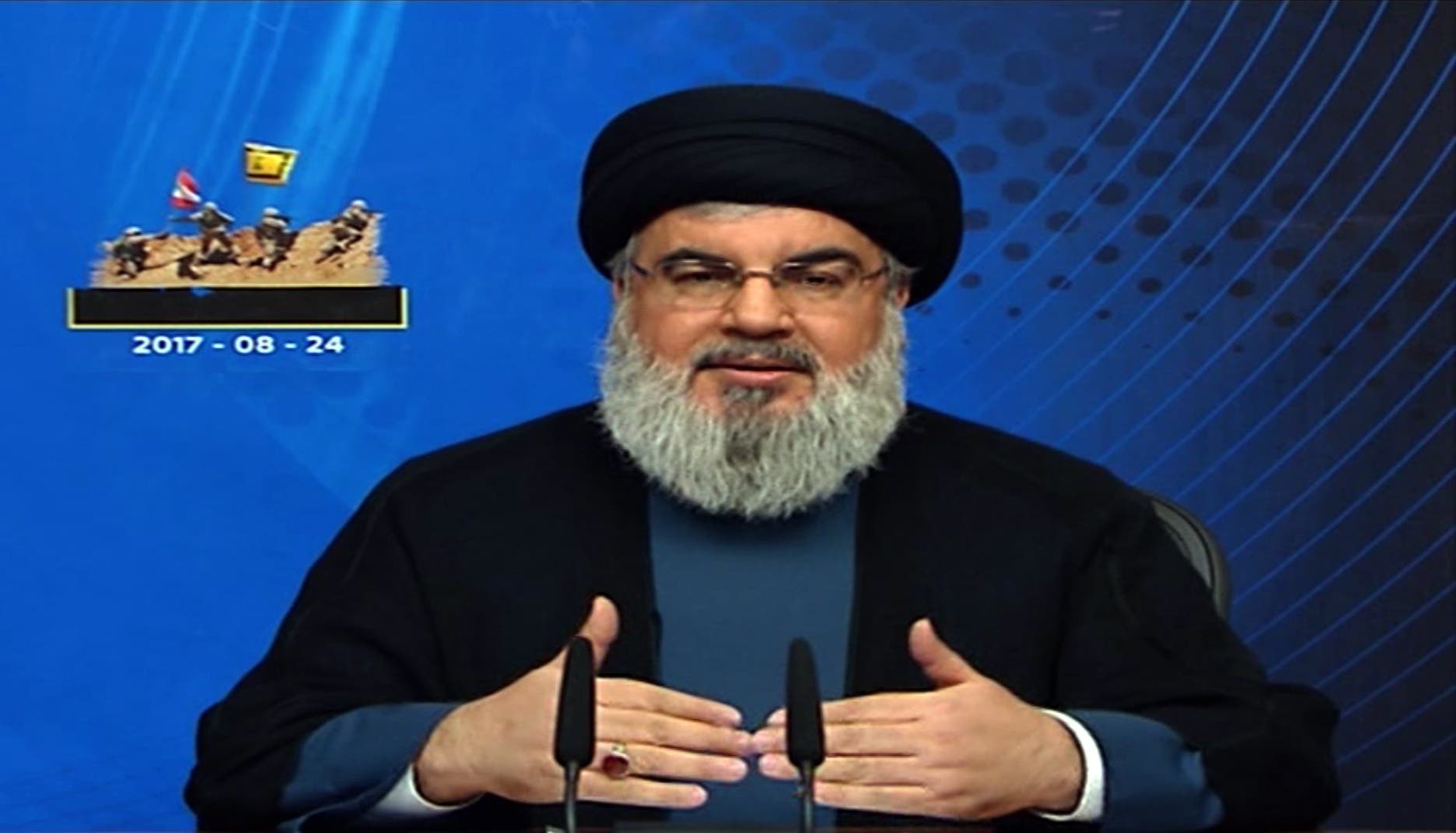
An image grab taken from Hezbollah’s al-Manar TV on August 24, 2017 shows Hassan Nasrallah, the head of Hezbollah. (AFP

Monday, September 4, 2017

ANALYSIS: The ‘Salvador Option’ in Iraq to promote Iran’s sway


Since the fall of Saddam Hussein, death squads have taken root in Iraq’s political core, and with the strengthening of Shiite militias by the Iranian regime, they have been used as a tool to inflict fear, to ensure that Iraq’s autocratic political body remains under Shiite control.
When Nouri Maliki’s Dawa Party came to power in Iraq in 2005 he had originally been appointed as vice-president for de-Baathification of the former Iraqi government and its military personnel. By April 2006, Maliki was installed as prime minister and with both the Americans and the Iranians looking on him as a politician they could easily influence, both were happy to back him during those early days.
As Maliki’s grip strengthened, his agenda for a Shiite dominated Iraq firmly took root, and it soon became apparent that the only future for Iraq under his divisive rule, came in the form of an Iranian satellite state. As he grew in stature, the Iranian regime’s plans for hegemonic control of Iraq began to take hold, and with the use of their subservient puppet in Baghdad; Shiite militias under their control began to wreak havoc across the country in the form of death squads.
Maliki’s marginalization of Sunnis had been an integral part of his premiership, while hitting back at so-called al-Qaeda terror groups that had been causing havoc in Iraq before the advent of ISIS, some of which had been attributed to “false flag” operations from other quarters. Maliki cracked down on any form of dissent in Sunni communities, where voices had been raised against his sectarian policies.
With many Shiite militia members serving in both the armed forces and the police force, Maliki used them to do his personal bidding, and running in line with a continuing violent program of de-Baathification. He used torture and extrajudicial execution to eradicate any sign of Saddam Hussein’s Baathist regime from the country, as well as marginalize Sunnis from political office.
source:ANALYSIS: The ‘Salvador Option’ in Iraq to promote Iran’s sway

New Light On Iran's Human Rights Violations


Two of the major crises the international community is currently engaged with are terrorism and nuclear proliferation. Iran, in particular, is negatively involved in both fields, being known as the central banker of international terrorism, and suspicious for its own controversial nuclear program at home parallel to its nuclear/missile collaboration with North Korea.
As these subjects are of significant importance and deserve even more attributed attention, what must not go neglected is the fact that Iran is taking advantage of such circumstances to continue an equally important campaign of belligerence against its own people. The scope of human rights violations carried out by Tehran is continuously on the rise, with the ruling regime interpreting the mentioned international crises as windows of opportunity to extend its domestic crackdown.
And yet, a promising report issued from the United Nations has shed very necessary light on a specific dossier Iran has gone the limits throughout the past three decades to cloak. In 1988 the Iranian regime carried out an atrocious massacre sending tens of thousands of political prisoners to the gallows. Unfortunately, the world has until recently remained silent in this regard.

Twenty nine years after the atrocious carnage, Asma Jahangir, the UN Special Rapporteur on the situation of human rights in Iran, issued a report on September 2nd for the first time referring to the massacre of over 30,000 political prisoners, mostly members and supporters of the Iranian opposition People's Mojahedin Organization of Iran (PMOI/MEK).
source:New Light On Iran's Human Rights Violations